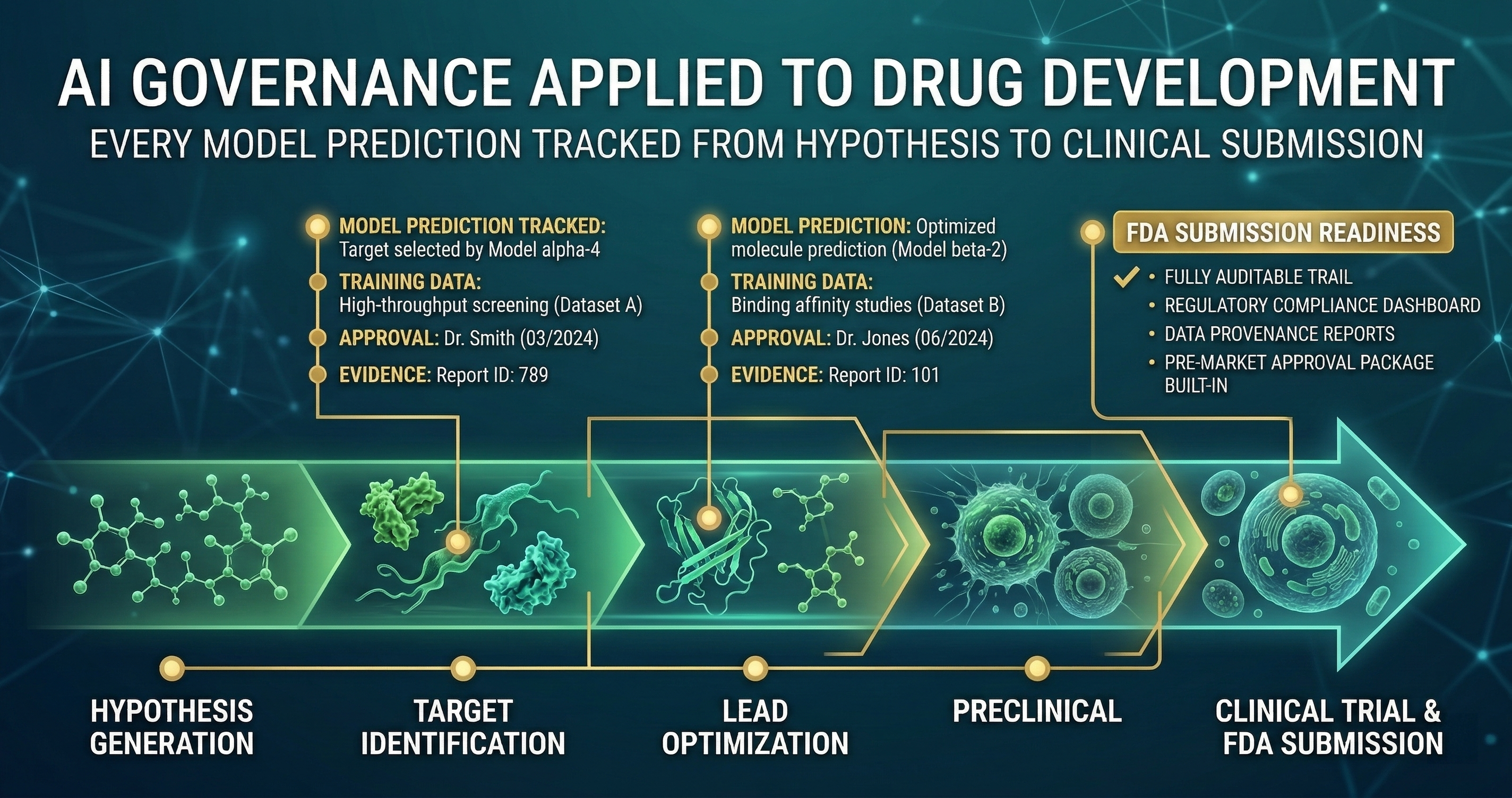
GuardSpine for Biotech: Governing AI in Drug Development
A single spreadsheet change in a clinical trial submission can delay an FDA approval by months. When AI assists that change, you need more than a checkbox.
A single spreadsheet change in a clinical trial submission can delay an FDA approval by months. When AI assists that change, you need more than a checkbox. You need evidence.
The biotech industry runs on data integrity. Every data point in a clinical trial, every calculation in a manufacturing process, every edit to a regulatory filing — all of it must be traceable, attributable, and verifiable. That requirement existed long before AI. AI just made it exponentially harder to satisfy.
The Biotech Governance Gap
Drug development generates enormous volumes of data. Genomic sequences, clinical trial results, manufacturing batch records, adverse event reports, regulatory correspondence. Increasingly, AI assists with analyzing, summarizing, and modifying this data.
Here’s what happens when AI touches biotech data without governance:
A data scientist uses an LLM to clean clinical trial data. The model removes what it identifies as outliers. Some of those “outliers” are legitimate data points from a subpopulation. The cleaned dataset goes into the submission. The FDA asks about the removed data points. Nobody knows which points were removed, why, or by which model version.
A regulatory affairs specialist uses AI to draft a section of an IND filing. The model pulls a statistic from its training data. The statistic is outdated. The filing goes out with an incorrect efficacy number. The FDA flags it. The correction costs weeks and damages credibility.
A manufacturing engineer uses AI to optimize a process parameter in a spreadsheet. The optimization changes three cells. One of those cells feeds into a formula that calculates a critical quality attribute. The attribute drifts out of specification. Nobody notices until batch release testing.
Each of these scenarios has happened. The common thread: AI made a change, nobody tracked what changed, and the consequences showed up later.
FDA 21 CFR Part 11: The Regulatory Frame
The FDA has thought about electronic records for decades. 21 CFR Part 11 defines the requirements for electronic records and electronic signatures. The rule was written in 1997, long before AI, but its principles map directly to the AI governance problem.
Electronic Records (11.10). Systems must maintain the ability to generate accurate and complete copies of records. For AI-assisted changes, this means you need the original data, the AI’s modification, the model that made the modification, and the rationale.
Audit Trails (11.10(e)). Computer-generated, time-stamped audit trails must record the date and time of operator entries and actions that create, modify, or delete electronic records. When AI is the “operator,” the audit trail must capture the model, version, prompt, and output.
Authority Checks (11.10(d)). The system must use authority checks to ensure that only authorized individuals can use the system. When AI acts on behalf of a user, the delegation must be explicit and the scope limited.
Electronic Signatures (11.50-11.100). Electronic signatures must be linked to their respective electronic records. When AI generates a recommendation and a human approves it, both the AI’s output and the human’s approval must be captured as distinct, linked records.
GuardSpine maps to each of these requirements through its guard lanes.
Three Guard Lanes for Biotech
SheetGuard: Clinical Data and Manufacturing Records
Clinical trial data lives in spreadsheets. So do manufacturing batch records, stability studies, and dosing calculations. When AI modifies a spreadsheet, SheetGuard captures exactly what changed.
Cell-level diffing shows which values were modified, what the previous values were, and whether formulas were affected. A change to a dosing calculation that propagates through a formula chain is tracked through every dependent cell.
The evidence bundle records:
- Which cells changed (coordinates, old value, new value)
- Whether any formula logic changed (not just values)
- Which model made or suggested the change
- The timestamp and user who approved the change
- The hash chain linking this evidence to the previous version
For 21 CFR Part 11 compliance, this evidence bundle IS the audit trail. It’s computer-generated, time-stamped, and immutable.
A common scenario: AI suggests adjusting a stability study timeline based on degradation kinetics data. SheetGuard captures the adjustment, the cells affected, and the downstream impact on expiration dating. The quality assurance team reviews the evidence bundle and approves or rejects the change. Both decisions are recorded.
PDFGuard: Regulatory Filings and Protocols
INDs, NDAs, BLAs, clinical study reports, investigator brochures — these are the documents that determine whether a drug gets approved. A single incorrect statement can trigger a refuse-to-file letter.
PDFGuard diffs document versions at the paragraph level. When AI assists with drafting or editing a regulatory filing, PDFGuard captures:
- Added paragraphs (with the model that generated them)
- Removed sections (with the reason, if provided)
- Modified text (with character-level diff highlighting)
- Changed figures or tables (with before/after comparison)
- Statistical claims (flagged for manual verification)
The FDA increasingly asks sponsors to describe their use of AI in submissions. PDFGuard evidence bundles answer that question with precision: “AI assisted with Section 7.3 (efficacy summary), generating the initial draft from study report CSR-2026-045. A medical writer reviewed and modified 12 paragraphs. The final text was approved by the medical director. Evidence bundle GSP-2026-0314 contains the complete modification history.”
CodeGuard: Computational Biology and Manufacturing Software
Drug development runs on code. Bioinformatics pipelines, PKPD modeling, statistical analysis, manufacturing execution systems, LIMS integrations. When AI writes or modifies this code, CodeGuard applies the same governance that software teams use.
Risk tiering matters here. A change to a logging function in a LIMS connector is L0. A change to a dosing calculation algorithm is L4. The classification determines the level of scrutiny: auto-approve for formatting changes, multi-model council review for anything that touches patient safety calculations.
For GxP-validated software, CodeGuard’s evidence bundles map directly to validation documentation requirements. Change control records, impact assessments, testing evidence — all generated as side effects of the review process.
The $406 Per Record Equation
Healthcare data breaches cost an average of $406 per compromised record, the highest of any industry. For biotech, the exposure is broader: a governance failure doesn’t just expose records, it can invalidate clinical trial data, delay drug approvals, or trigger regulatory enforcement actions.
Consider the cost chain:
Data integrity failure -> FDA audit finding -> clinical hold -> delayed approval -> lost revenue
A clinical hold on a Phase 3 trial can cost tens of millions in delayed revenue. A refused-to-file NDA can set a program back by years. An FDA warning letter about data integrity can affect every product in your pipeline, not just the one that triggered it.
The governance investment is small compared to the downside. A system that automatically generates 21 CFR Part 11-compliant audit trails costs a fraction of what a single data integrity finding costs to remediate.
ALCOA+ and Evidence Bundles
FDA data integrity guidance uses the ALCOA+ framework: Attributable, Legible, Contemporaneous, Original, Accurate, plus Complete, Consistent, Enduring, Available.
GuardSpine evidence bundles satisfy each criterion:
Attributable. Every change links to a specific model, version, and approving user. The delegation chain from AI output to human approval is explicit.
Legible. Evidence bundles export in human-readable formats. JSON for systems, PDF summaries for reviewers, ZIP archives for auditors.
Contemporaneous. Evidence is generated at the time of the change, not reconstructed later. Timestamps are system-generated, not user-entered.
Original. The evidence bundle contains the original diff, not a summary. Hash chains ensure the original hasn’t been modified after the fact.
Accurate. The evidence reflects what actually happened in the code, spreadsheet, or document. It’s generated by evaluating the actual artifact, not by asking someone to describe what they did.
Complete. Every change that passes through a guard lane generates evidence. There are no gaps where changes happen without records.
Consistent. The same evidence format applies across all guard lanes. A code change and a spreadsheet change produce structurally identical evidence bundles.
Enduring. Hash chains ensure evidence integrity over time. Evidence sealed today can be verified years later without access to the original system.
Available. Export in standard formats (JSON, SARIF, ZIP) ensures evidence is accessible to any system that needs it.
Getting Started in Biotech
Start with the highest-risk area. For most biotech companies, that’s the intersection of AI and clinical data — the place where an untracked change has the largest regulatory impact.
Install SheetGuard on the spreadsheets that feed your regulatory submissions. Every AI-assisted modification gets evidence. Quality assurance reviews the evidence instead of re-checking every cell manually.
Add PDFGuard when you start using AI for document drafting. The evidence trail answers the FDA’s questions about AI use before they ask.
Add CodeGuard when your computational biology or manufacturing software teams adopt AI-assisted coding. The risk tier system ensures that a change to a statistical model gets council review while a change to a log format gets auto-approved.
The evidence accumulates. By the time an auditor asks about your AI governance, you have thousands of tamper-evident records showing exactly what AI did, who approved it, and what evidence supports the decision.
That’s not a checkbox. That’s a system.
Building AI-assisted biotech systems and need governance that satisfies FDA 21 CFR Part 11? Book a call and bring your validation requirements. I’ll map the guard lanes to your regulatory framework.