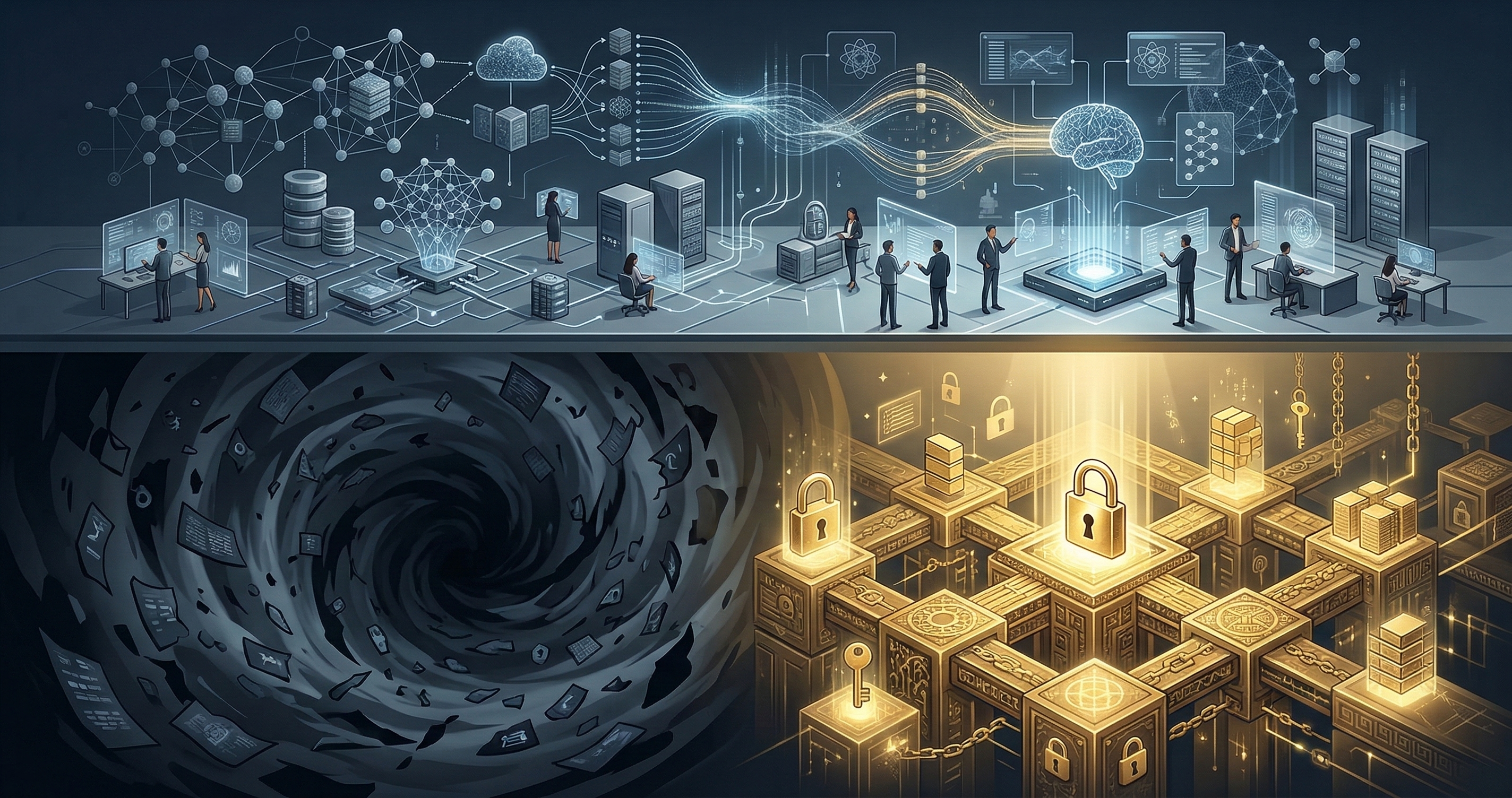
Why AI Code Review Needs Governance, Not Just Automation
AI can review code faster than any human. But speed without proof is just rubber-stamping with extra steps. The gap between AI reviewing code and proving it reviewed correctly is where governance lives.
Every AI code review tool on the market can tell you whether a function looks correct. None of them can prove they actually checked.
That distinction sounds academic until an auditor asks for evidence that your AI-reviewed payment processing change was actually reviewed against your security policy. Then it becomes the most expensive distinction in your codebase.
The Rubber-Stamp Problem
I have watched teams adopt AI code review with genuine excitement. Copilot, CodeRabbit, Cursor — the tools are impressive. They catch bugs humans miss. They flag patterns across thousands of files. They work at 3 AM when nobody else does.
But here is what happens in practice:
- AI reviewer posts a comment on the PR
- Developer reads it (maybe)
- Someone clicks approve
- The change merges
Where is the evidence? A comment on a PR. That comment proves the AI ran. It does not prove the AI checked against your specific security policy. It does not prove the AI’s recommendation was followed. It does not prove the AI even saw the final version of the diff — the developer might have force-pushed after the review.
This is rubber-stamping with better marketing. The green checkmark means exactly what it meant before AI: someone (or something) clicked a button.
Automation vs. Governance
Automation answers: “Did something review this code?”
Governance answers: “Can I prove what was reviewed, what rules applied, what risks were identified, and why the outcome was acceptable?”
These are fundamentally different questions. Automation is a tool. Governance is a system. You can automate without governing, and the result is fast, unaccountable change. You cannot govern without some form of automation at scale, but the automation serves the governance — not the other way around.
The confusion between these two concepts is costing companies real money. I have seen SOC 2 audit findings specifically citing “insufficient evidence of AI-assisted change review.” The auditor does not care that you use Claude to review PRs. The auditor cares that you can demonstrate what Claude checked, what it found, and why the merge was authorized.
What Proof Actually Looks Like
Real governance proof for an AI code review has five components:
The diff at review time. Not the final merged diff. The exact diff the AI reviewer saw when it generated its assessment. If someone pushed changes after the review, that gap needs to be visible.
The rules that applied. Which security policies, coding standards, and compliance requirements were checked? Not “we ran our AI reviewer” but “the AI evaluated this change against rules X, Y, and Z.”
The risk classification. Was this a low-risk documentation change or a high-risk authentication modification? The review depth should match the risk level, and the evidence should show that it did.
The reviewer assessments. What did each reviewer (human or AI) actually conclude? Not a pass/fail binary but a structured assessment with specific findings.
The authorization chain. Who or what authorized the merge, based on what evidence, at what time? This chain needs to be tamper-evident — not just a database record that someone could edit after the fact.
If your AI code review tool produces anything less than these five components, you have automation. You do not have governance.
Why One Reviewer Is Not Enough
A single AI model reviewing code has the same problem as a single human reviewer: blind spots. Claude is excellent at catching logical errors but can miss performance regressions. GPT-4 flags security patterns that Claude sometimes overlooks. Gemini catches dependency issues that both miss.
This is not a theoretical concern. I built multi-model review into GuardSpine after watching single-model reviews miss a SQL injection vulnerability that a second model caught immediately. The first model focused on the business logic (which was correct) and treated the database query as a standard pattern. The second model recognized the string interpolation as a parameterization failure.
One model gives you an opinion. Multiple models give you a consensus. Consensus with documented dissent gives you defensible evidence.
The GuardSpine Approach
GuardSpine treats AI code review as a governance problem, not an automation problem. Every change goes through a pipeline:
- Classify the change by risk tier (L0 through L3)
- Route to the appropriate review depth based on that classification
- Review using multiple AI models that evaluate against your specific rules
- Seal the entire process — diff, rules, assessments, authorization — into a cryptographically signed evidence bundle
- Verify independently, offline, without trusting GuardSpine’s servers
The evidence bundle is the product. Not the review comments. Not the dashboard. The sealed, verifiable proof that governance actually happened.
This matters because trust without evidence is just faith. And faith does not pass audits.
What Changes When You Have Proof
Teams that adopt governance over raw automation report three consistent outcomes:
First, audit preparation drops from weeks to hours. The evidence bundles are the audit trail. No scrambling to reconstruct what happened six months ago.
Second, developer trust in AI reviews increases. When the system shows exactly what was checked and what was found, developers stop treating AI reviews as noise and start treating them as signal.
Third, the conversation with security and compliance teams shifts from “can we use AI tools?” to “here is the evidence that our AI tools are governed.” That shift unlocks adoption instead of blocking it.
The Bottom Line
AI code review is not going away. It is getting faster, cheaper, and more capable every quarter. The question is not whether to use it. The question is whether you can prove it works.
Governance is the answer to that question. Not more automation. Not better prompts. A system that captures evidence, seals it cryptographically, and lets any third party verify it independently.
If your team is generating AI-reviewed code without governance evidence, you are accumulating compliance debt at the speed of your AI tools. That debt compounds.
I built GuardSpine to stop that compounding. If you want to see how evidence-based governance works on your actual codebase, book a demo at cal.com/davidyoussef/guardspine.