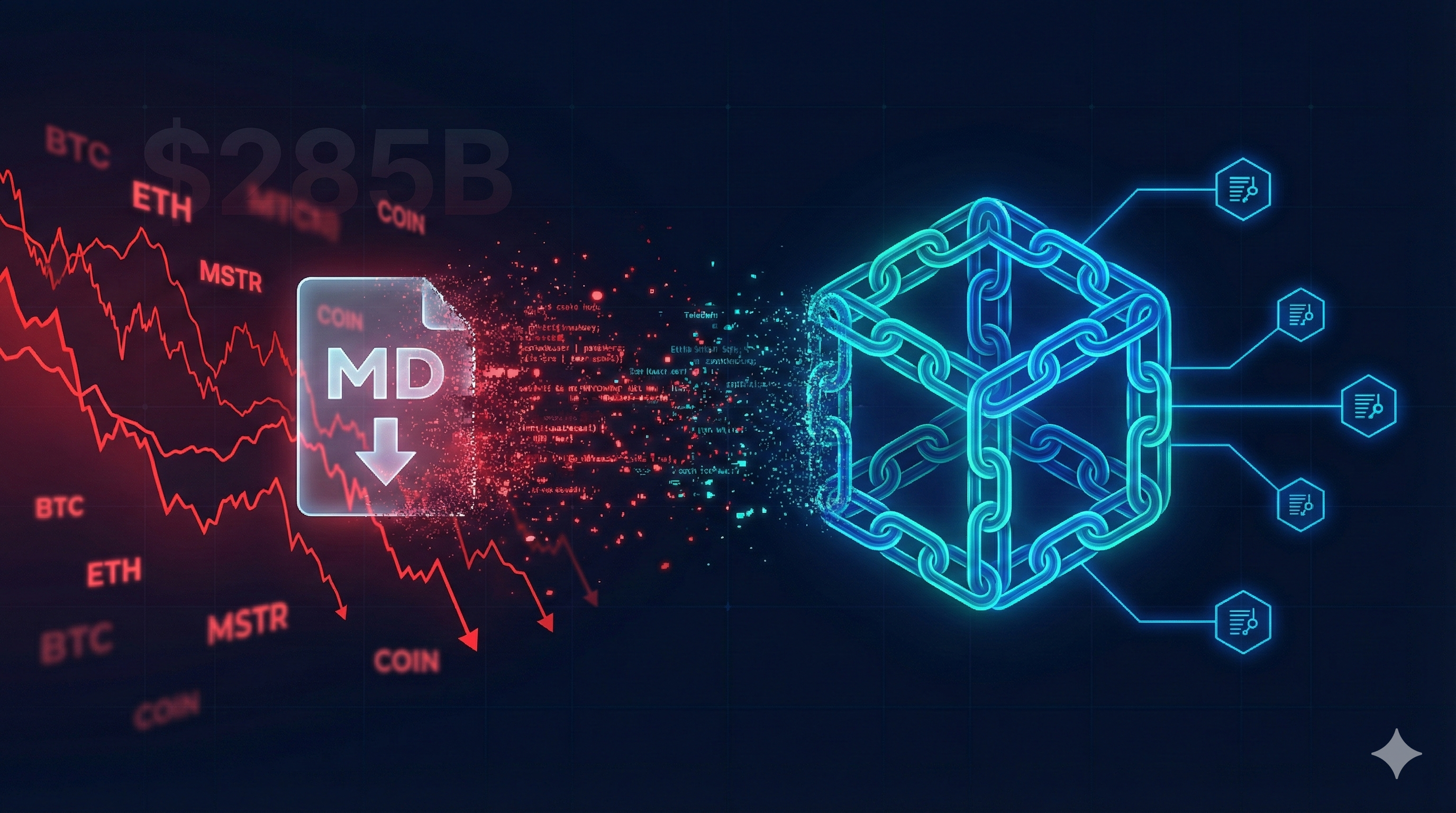
The $285 Billion Crash Predicted Our Product
A markdown file wiped $285 billion off the stock market. Every analyst who dug into it landed on the same conclusion: the next premium in enterprise software is proof of process. They described our evidence bundles without knowing we exist.
Everyone’s talking about a markdown file that wiped $285 billion off the stock market. They’re not wrong about the number. They’re wrong about what it means.
On January 30th, Anthropic shipped a set of open-source plugins for Claude Co-work. One handles legal contract review — triaging NDAs, flagging non-standard clauses, generating compliance summaries. About 200 lines of structured prompts. First-year law school content with clever workflow logic.
Thompson Reuters dropped 16%. LexisNexis parent RELX fell 14%. LegalZoom cratered 20%. Private equity firms like KKR and TPG lost 10%.
The narrative hardened fast: “AI startup crashes the software market.” That framing is fun for headlines. It misses the structural story entirely.
The crash wasn’t about a prompt file
Every major enterprise software company — Salesforce, ServiceNow, Adobe, Thompson Reuters, LexisNexis — runs on per-seat licensing. One human, one login, one license fee. Revenue scales linearly with headcount.
That model works when humans are the bottleneck. It breaks when an AI agent does the work of ten humans without logging in.
Jensen Huang made the counterargument at the Cisco AI Summit: “AI doesn’t replace software. AI runs on software.” He’s right about the product. He’s wrong about the pricing. Nobody serious argues the world needs less software. The argument is that the world no longer pays for software the way it currently pays for software.
Print media made this exact mistake. Newspapers had content people wanted — local news, investigative reporting, weather. The internet didn’t make the content worthless. It destroyed the access model. The content survived. The business model didn’t.
Enterprise data moats — Thompson Reuters case law, Salesforce customer graphs, Adobe creative workflows — those survive. The per-seat access pricing on top of that data does not.
The KPMG story matters more than any stock chart
While everyone watched Thompson Reuters drop, a quieter story broke. KPMG pressured Grant Thornton UK — their own auditor — to cut audit fees. The argument: AI reduces the cost of the work, so your old prices aren’t justified.
Grant Thornton resisted. KPMG’s response, per the Financial Times: lower your prices or we find a new auditor. Grant Thornton blinked. Fees dropped 14%.
This is the pattern that changes everything. KPMG didn’t automate their audit. They didn’t replace anyone with AI. They used the existence of AI as a negotiating weapon.
That playbook works in every knowledge-work fee negotiation. Audit fees today. Legal fees next. Then consulting, implementation, design — every form of billing that scales with the number of humans touching the work.
You don’t need to deploy AI at scale. You just need buyers pointing at the $285 billion crash and saying: “We both know the world changed. Let’s talk about your rates.”
The market is telling us exactly what becomes valuable next
If generation gets cheap, verification gets expensive. If AI agents produce the work, someone still has to prove what happened, why it happened, and who approved it.
Here’s the uncomfortable truth: the crash is the single strongest demand signal for governance infrastructure I’ve ever seen.
When I started building GuardSpine, the thesis was simple. AI agents will do more of the work. The hard part won’t be generating code or analysis — it’ll be proving that the right process happened, the right models reviewed it, and someone accountable signed off.
That thesis just got a $285 billion confirmation.
GuardSpine’s evidence bundles do exactly what the post-crash analysis says the market needs:
- Hash-chained event logs. Every action in the review — PR opened, analysis complete, risk classified, approval recorded — gets a cryptographic hash. Tamper with any event and the chain breaks. Forensic replay of exactly what happened and why.
- Multi-model attestation. Higher-risk changes get reviewed by more AI models. The bundle records which models ran, what they found, and whether they agreed. Not self-reported confidence — deterministic, auditable evidence.
- Risk-tiered governance. L0 through L4. Docs and formatting get auto-approved. Auth changes and payment code require human sign-off from three AI models. The tier drives the rigor. The bundle proves it.
- Compliance rubrics built in. SOC 2, HIPAA, PCI-DSS as configuration flags. The evidence bundle becomes the audit artifact procurement teams will demand — the same way they demand SOC 2 reports today.
This is not a chatbot bolted onto a code review tool. This is what the analysts who dissected the crash called “monetizable trust infrastructure” — evidence that the right process happened, produced by the same system that ran the process.
The governance layer is where pricing moves next
The smartest analysis of the crash pointed out something most people missed: if per-seat pricing dies, vendors need new meters. Per-action. Per-decision. Per-dollar-of-risk-covered. Per-audit-ready-output.
That’s exactly how GuardSpine works. Not per-seat. Per-PR-governed. Per-bundle-sealed. The meter is the governance decision, not the human in the chair.
Every AI agent that replaces a paralegal still needs the case law database. Still needs the CRM. Still needs document management. The data edge is real. But the new premium isn’t access to data — it’s proof that the data was used correctly, by the right process, with the right approvals, producing evidence that holds up under scrutiny.
That proof is what we build.
The clock is running
The crash compressed a transition everyone expected to take five years into a 48-hour repricing event. The repricing hasn’t stopped.
Companies that bolt AI onto existing products and keep charging per-seat are dead. Companies that rebuild around agentic-first architecture and charge for data value plus accountability will own the next decade of enterprise software.
The same logic applies to every team shipping code with AI assistance. You’re generating faster than ever. The question your auditor, your regulator, and your board will ask next is: can you prove what happened?
We built the answer before they asked the question.
Ready to see what governance infrastructure looks like for AI-assisted development?
GuardSpine ships as a GitHub Action. Five-minute install. Evidence bundles on every PR. No slides, no theory — just a working system you can verify yourself.
Book a free 30-minute walkthrough
Install it now: 5-Minute Quickstart
Verify a bundle: pip install guardspine-verify